

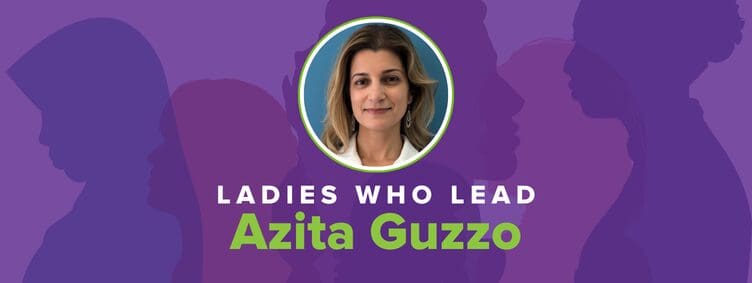
Throughout Women’s History Month, our “Ladies Who Lead” series highlights the women across Longbridge whose leadership, expertise, and perspective help shape our company and inspire those around them. Their stories remind us that leadership takes many forms—and that progress often comes from those willing to challenge the status quo and think differently.
This year’s theme from the National Women’s History Alliance, “Leading the Change: Women Shaping a Sustainable Future,” highlights the many ways women today are driving meaningful change that will impact generations to come.
Our next featured leader is Azita Guzzo, Head of Technology Innovation at Longbridge. We spoke with Azita about the women who have inspired her, the importance of mentorship and collaboration, and the lessons that have shaped her journey in the technology field. Let’s get into the Q&A.
Q: What does Women’s History Month mean to you?
A: My perspective is a little different from many women who grew up in the United States. I was raised in another country where women didn’t always have the same opportunities or freedoms.
Because of that, I’ve been more familiar with International Women’s Day than Women’s History Month until recently. Learning about it has been interesting, and I think it’s a wonderful opportunity to reflect on the many contributions women have made throughout history and across different fields.
It’s also a reminder of how fortunate we are to live in the United States, where women have many opportunities to build careers, lead organizations, and shape their own futures.
Q: Which women’s stories throughout history need to be heard and supported more?
A: Marie Curie comes to mind immediately. She broke the glass ceiling long before anyone even knew there was glass to break. She was a brilliant scientist and a true pioneer in her field, but also a devoted wife and the mother of two daughters.
Curie’s story reminds us that women have always been capable of extraordinary achievements while also raising families. Like anyone balancing work and life, she made sacrifices along the way, but what she accomplished remains remarkable.
Q: How could you contribute your wisdom, expertise, or ideas to empower other women?
A: I try to share the knowledge I’ve learned over the years and mentor women who are building their careers. One piece of advice I often share is to see men in the workplace as mentors and partners rather than obstacles. Success often comes from collaboration — learning from the people around you and building strong professional relationships. When we approach our careers with that mindset, it can create opportunities for growth and mutual support.
Q: How does Longbridge set a culture of equality and inclusivity?
A: Longbridge doesn’t just talk about equality and inclusivity, it demonstrates it. If you look across the company, you’ll see women leading departments where they’ve historically been underrepresented, like IT and Finance.
One of our three top executives, Melissa Macerato, is a woman many of us admire and look up to. To me, that says a lot about the culture here. At Longbridge, people are recognized and promoted based on merit, talent, and leadership, regardless of gender. That kind of environment makes it a great company to be part of.
Q: Who is your female role model?
A: First and foremost, my mother. She taught me to be strong. I grew up in a country where women are often treated as second-class citizens, and it was her strength — and the way she raised me — that helped shape the woman I am today.
I also love history and enjoy reading about women leaders who made a lasting impact. One of my favorites is Margaret Thatcher. Regardless of politics, what I admire most is her determination, discipline, and the confidence she had to lead during a time when very few women held positions of power. She demonstrated that strong leadership and conviction are not defined by gender. Thatcher was also a wife and a mother while carrying the responsibilities of leadership, which makes her story even more impressive.
Q: What is one piece of advice to women who are juggling between home and work?
A: I may not be the best person to give advice here since I’m not a mother myself. In fact, seeing women successfully manage both work and family responsibilities only deepens my admiration for them.
However, I once heard a story from a colleague that stuck with me. After having her first child, she chose to step away from her career for a period of time. Not everyone has that option, of course, but the point she made was powerful: life and careers can happen in phases. You may work intensely early in your career, take time for family when needed, and return later. Today she is the CFO of a healthcare company. To me, it’s a great reminder that taking a pause doesn’t mean the story is over — it’s simply another chapter.
Q: What advice would you give women struggling in a male-dominated industry?
A: First, believe in your expertise and don’t be afraid to speak up. Your ideas and knowledge are just as valuable as anyone else’s in the room. Second, view your male colleagues as partners and potential mentors rather than barriers. Many can become strong allies throughout your career. Focus on continuing to learn, building credibility through your work, and staying confident in your abilities. Over time, respect follows results.
Q: Any tips for women who are looking for a mentor?
A: Don’t be afraid to reach out and ask. In my experience, many professionals are more than willing to share what they’ve learned. It’s also important not to limit yourself to only female mentors. Some of the most valuable mentorship relationships can come from men who are willing to guide and support your growth. Look for someone you respect, who is generous with their knowledge, and genuinely interested in helping others succeed.
Q: What do you think helped you get this far in your career?
A: I’ve always worked very hard and have never been afraid to take on a challenge or step into something new. My personal motto has always been that there is very little I cannot do if I put my mind to it — except for singing. No amount of determination is going to turn me into a singer!
Along the way, I’ve also been fortunate to have great mentors, many of whom were my direct managers who helped guide my professional growth. I give a lot of credit to my husband as well, who has always been incredibly supportive of my career. Having people around you who believe in you makes a tremendous difference.
I also credit my father. From an early age, he taught me about money and how businesses operate. As someone who built a career in technology, that perspective helped me tremendously. Many technical professionals focus only on the technology, but thinking about the business side comes naturally to me because of what he taught me.
Q: Do you believe you’ve achieved everything you wanted to?
A: Not everything, but I’m very happy with my life. Over time, I’ve learned that fulfillment comes from continuing to grow, learning new things, and building something worthwhile. As long as I’m moving forward and contributing in a meaningful way, I feel satisfied with where I am.
Q: What would you say to your 20-year-old self?
A: I would share something I only came to understand much later in life after reading Man’s Search for Meaning by Viktor Frankl. The lesson that stayed with me is that the true source of happiness is meaning and purpose in life. Even during hardship or suffering, life still has meaning. While we can’t always control what happens to us, we can control how we respond.
I’ve found that people tend to find meaning in three ways: work or accomplishments they create, love and relationships, and their attitude when facing difficult challenges. I wish I had understood that earlier in life.
Thank you, Azita, for sharing your perspective and for the leadership you bring to the Longbridge team. Your journey is a powerful reminder that resilience, curiosity, and a willingness to embrace new challenges can open doors to remarkable opportunities.
About Women’s History Month
The celebration of Women’s History Month began in 1981 when Congress authorized President Jimmy Carter to proclaim “Women’s History Week.” In 1987, following efforts led by the National Women’s History Alliance, the observance was expanded to the entire month of March.
Each year, Women’s History Month recognizes the countless contributions women have made across industries, communities, and generations—while inspiring continued progress toward equity and opportunity for all.